

Ask ChatGPT which company a buyer in your category should hire and you get a short list of names. Ask Perplexity the same thing in a different language and the list changes. Ask again next week and it shifts once more. Your brand is either on those lists or it isn't, and nothing in your reporting stack tells you which.
That blind spot produced a discipline of its own: answer engine optimization (AEO), used interchangeably with generative engine optimization (GEO). It needs its own measurement tools, because the existing ones do not fit. Buyers increasingly open an assistant instead of a search box, which means a growing share of purchase decisions is now shaped by text nobody on your team has ever read. Google Search Console will never tell you how often ChatGPT names your company, which competitor it names instead, or which page it cited to justify the recommendation. In this article I'll explain what AEO/GEO is, how it differs from SEO, and how Ansvisor, an open source and self-hosted AI visibility platform, measures the stretch of the buying journey your analytics cannot see today.
In this article:
- What is answer engine optimization (AEO/GEO)?
- AEO/GEO vs SEO: what actually changes?
- What does Ansvisor do?
- Why open source and self-hosted matters for AI visibility
- What is the best answer engine optimization tool?
- How do you get started with Ansvisor?
- FAQ
- Summary
What is answer engine optimization (AEO/GEO)?
Answer engine optimization is the practice of making sure AI assistants name and cite your brand when someone asks them a question in your category. It is not about a spot in a list of links. It is about whether your name shows up in the answer itself, the one a model backs with two to five sources.
This works differently from a classic search engine, because the model does not assemble a list of pages, it writes the answer itself. It draws on what it learned earlier and on what it pulls from the web at that moment. Brands that make it into those answers have three things: a lot of content on the topic rather than one good page, text you can lift a ready-made fragment from (comparison tables, question-and-answer sections, specific names and numbers), and confirmation from someone else, meaning reviews, roundups and forum threads. That last one lowers the risk that the model gets it wrong, so the model leans on it happily.
Read also: AI agent in business: 15 ideas for what it can do in 2026, including an agent that monitors competitors and an agent that produces content, which is exactly the work that earns mentions in AEO/GEO.
AEO/GEO vs SEO: what actually changes?
Both feed on the same content you publish. What changes is where you compete for the customer, and how you check whether that competition is going well.
| SEO | AEO/GEO | |
|---|---|---|
| Where you show up | Google results list | The assistant's answer |
| What you fight for | A high ranking | The model naming your brand |
| Where the model gets it | Crawled HTML and links | Training data plus what it pulls live |
| What you measure | Position, impressions, CTR | How often it names you, what it cites, in what tone |
| How fast you see results | Weeks to months | Days, because models fetch content again quickly |
| What gives you an edge | Long-form content and links | Text a ready answer can be lifted from |
The practical consequence is uncomfortable. In SEO you fight for a position and a click. In AEO/GEO you fight to be named at all, and there is often no click to measure afterwards. Someone who reads "for this kind of project, consider vendor X" and then goes straight to that vendor's contact form arrives as direct traffic, or as a referral from a domain the reports have never seen before.
This is also why a single number is misleading. The same brand routinely scores near 100% on questions asked in its home language and 0% on generic English shortlists in the same week, or gets named by one engine and ignored by another for an identical query. An averaged percentage smooths over those extremes and says nothing about where to act. Read visibility separately for each engine, language and question type, not as one number on a dashboard.
What does Ansvisor do?
Ansvisor is an AI visibility platform that runs your prompts against answer engines on a schedule, parses what comes back, and turns it into metrics you can act on. Work starts from a brand and its competitors, and every analytics module in the left-hand navigation is fed by the scheduled runs for that brand.
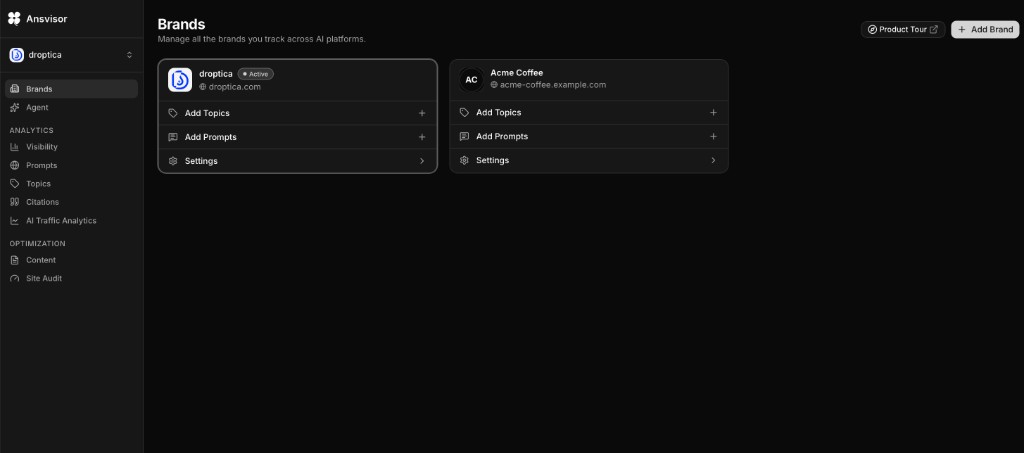
Version 0.1.7 covers the following:
- Answer engine insights — visibility scores across ChatGPT, Google AI Overview, Google AI Mode, Gemini, Perplexity, Microsoft Copilot, Grok and Claude, with weekly trends
- Prompts and topics — track unlimited natural-language queries, cluster them by intent, and see monthly search volume per prompt
- Citations — every URL an engine cited alongside your brand, classified by source type: news, reviews, owned pages, social media, forums
- Competitors — head-to-head comparison against named competitors and the prompts where they are cited and you are not
- AI traffic analytics — a tracking pixel that measures real visits arriving from AI answers, split by platform, landing page and country
- Content optimization — AI-generated briefs with title, outline and target keywords, delivered to your CMS through a webhook
- MCP server — query your own visibility data from Claude, Cursor or any MCP client instead of opening the dashboard
- Multi-language — 13 languages and 18 regions, which matters if your zeros are concentrated in one market
The MCP server is the part most teams underestimate. Once your visibility data is reachable over the Model Context Protocol, an agent can pull it into a weekly report or a content brief without a human exporting anything.
Read also: Why your company needs a CLI for AI agents — the same argument for making internal data reachable by agents.
Why open source and self-hosted matters for AI visibility
Every commercial AI visibility tool reports a score. Almost none of them tell you how the score is calculated. That is the practical difference here, and it comes down to three arguments.
Your prompts stay your prompts
The prompt set you track is a map of your commercial strategy: the segments you want, the competitors you fear, the objections you expect. Ansvisor running on your own server keeps that map, and every scraped response, inside your own Supabase project and your own infrastructure. Nothing reaches a vendor's servers.
MIT licensing instead of per-seat pricing
Ansvisor is MIT licensed, so the software costs nothing and there is no seat count to negotiate. What you do pay for is the work: your AI provider bills plus scraping. For a brand tracking 30 prompts daily across four engines, that lands between 5 and 15 USD per month in API fees. Compare that to the entry price of an AI visibility add-on from a large SEO suite.
The scoring formula is in the repository
This is the argument that turns out to matter most once you start reporting to a board. Ansvisor's visibility score is a 0 to 100 number built from three weighted components: mention count at 50%, capped at five mentions so a spammy response cannot skew the result, position of the first mention at 25%, and citation presence at 25%. You can read that in the docs, then read the code that implements it, then change the weights if your category needs different ones. When someone asks why the number moved, you can answer with the formula rather than with a vendor's marketing page.
What is the best answer engine optimization tool?
The honest answer is that it depends on what matters most to you, so here is the version without the sales pitch. Semrush, Ahrefs Brand Radar and Profound are mature, hosted, and staffed by support teams. If you want a tool your team can use on Monday with zero infrastructure work and a procurement process that already approves SaaS, they are a reasonable choice.
Ansvisor is the better fit when at least one of these is true:
- your prompt set or your client data cannot leave your infrastructure
- you need more than a handful of seats and per-seat pricing kills the business case
- you need to explain, defend or modify how the visibility number is computed
- you want AEO/GEO data inside your own agents and pipelines through MCP or webhooks
- you track brands in languages and regions that hosted tools cover poorly
| Managed cloud | Self-hosted | |
|---|---|---|
| Setup | Sign up, add a brand | Supabase project, two env files, Docker |
| Where data lives | Vendor infrastructure | Your infrastructure |
| Software cost | Monthly subscription | Free, MIT licensed |
| Running cost | Included in the plan | Your AI provider and scraping bills |
| Features | Full, some gated by plan | Full, nothing gated |
| Maintenance | Vendor handles it | You handle upgrades and backups |
Ansvisor itself exists in both forms. The managed cloud at ansvisor.com is the same codebase, hosted for you, and the self-hosted build has no paywalled features.
How do you get started with Ansvisor?
There are two paths. The decision is mostly about who holds the data rather than about features.
The cloud path takes minutes. Create an account at ansvisor.com, add your brand and your competitors, paste in 20 to 30 prompts your buyers would realistically ask, and wait for the first daily run. Prompt quality matters more than prompt count here, so start with the questions that precede a purchase, not with your product name.
The self-hosted path needs a Supabase project and about half an hour:
git clone https://github.com/ansvisor/ansvisor.git
cd ansvisor
cp web/.env.example web/.env.local
cp server/.env.example server/.env
# paste supabase/schema.sql into the Supabase SQL editor, then:
docker compose up --build
Two credentials decide whether the first run produces anything: a key for at least one AI provider (OpenAI, Anthropic or Gemini) for the engines exposed through APIs, and a Cloro key for the web engines that have no public API, ChatGPT search among them. DataForSEO for prompt volume and Scrape.do for site audit are optional. Node.js 20 or newer is required. The full setup, including environment variables and upgrades, is documented at docs.ansvisor.com.
FAQ
Short answers to the questions that come up most often when teams evaluate AI visibility tracking.
How is AEO different from GEO?
Practically not at all, both abbreviations describe the same work and are used interchangeably. AEO comes up more often around tools that hand you a finished answer, such as ChatGPT and Perplexity, while GEO gets stretched to cover any model-generated output. Measurement is identical in both cases, so the choice of abbreviation only changes the vocabulary in your slide deck.
Can I track my brand in ChatGPT for free?
You can ask the question manually and read the answer, which is worth doing once. It does not scale, because a single answer is one shot, and answers shift by day, language and phrasing. Self-hosted Ansvisor is free as software, but the scheduled runs still consume API and scraping credits.
Which AI engines can Ansvisor monitor?
Eight: ChatGPT, Google AI Overview, Google AI Mode, Gemini, Perplexity, Microsoft Copilot, Grok and Claude. Programmable engines are queried through official APIs, web-only engines through a third-party scraping service.
Do I need my own OpenAI or Anthropic key?
For self-hosting, yes, at least one provider key plus a scraping key. That is also the point: you see and control the cost, and you can throttle per-engine frequency to keep it down.
Is self-hosted Ansvisor limited compared to the cloud version?
No. Setting IS_CLOUD=false unlocks every feature, and payment configuration is not needed. The cloud version is the same code with the infrastructure, quotas and support handled for you.
Summary
- Read AI visibility separately for each engine and language, not as one number. A brand can be named in every local-language answer and missing from every English shortlist in the same week
- Answer engine optimization, or AEO/GEO interchangeably, targets brand mentions inside generated answers, where there is frequently no click you could attribute
- Ansvisor tracks eight engines, plus citations, competitors, tone and real AI-referred traffic through a pixel
- It is MIT licensed and self-hostable, so prompts and responses stay on your infrastructure and the software costs nothing
- The visibility formula is public: 50% mention count, 25% position, 25% citation presence, with the implementation in the repository
- Running cost for 30 prompts daily across four engines is between 5 and 15 USD per month in provider fees
Want to know how AI engines describe your company?
Start with the uncomfortable experiment. Take the five questions a prospect asks right before they shortlist a vendor, ask them in every language you sell in, and count how often your name appears. If the result surprises you, the Ansvisor repository is a good place to make that measurement continuous instead of a one-off, and a star helps the next team find it.
At Droptica we deploy open source AI tooling for companies that would rather own their data and their method than rent both. If you want AI visibility tracking wired into your own infrastructure, your content workflow and your agents, take a look at our AI agents for marketing services or get in touch.

